Zoom microscope system · MZS Series
Hikrobot MV-MZS300H-100(Kit)
- Lead time
- from 5 days
- Warranty
- 36 months
Bench inspection and alternatives
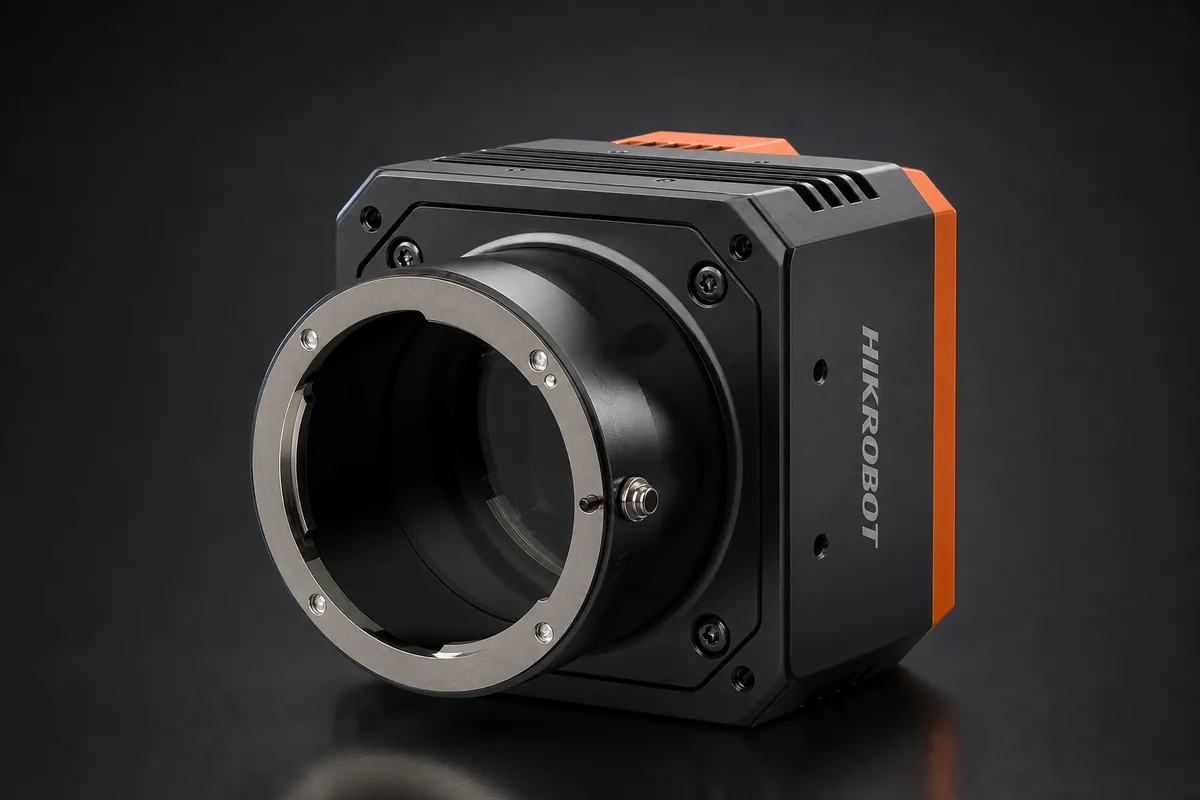
Balanced-detail HDMI microscopy is the operating position of MV-MZS300H-100(Kit). A 1/1.88-inch color CMOS sensor delivers 2560 × 1440 at a maximum of 30 fps, with 2.9 µm × 2.9 µm pixels and rolling-shutter exposure. The camera accepts C-mount optics, and the stated kit dimensions cover the imaging head and the supporting microscope components.
This 3.7 MP format fits bench inspection of stationary components, verification of assembly features, and live positioning where more detail than Full HD is needed. The physical layout includes a 75 mm × 75 mm × 86.9 mm camera, Φ58 mm × 166.3 mm lens, Φ97 mm × 123.5 mm light source, 380 mm × 260 mm × 23 mm base, and Φ25 mm × 341 mm stand. HDMI carries the color image.
MV-MZS200H-100(Kit) changes the balance to 1920 × 1080 at 60 fps, favouring live refresh over resolution. MV-MZS300H-300(Kit) preserves the 2560 × 1440, 30 fps sensor combination but is documented as a 277 mm × 320.2 mm × 511.4 mm system variant. MV-CM3040C-1H shares the 3.7 MP imaging values and measures 75 mm × 75 mm × 86.9 mm.
Specifications
| Nominal optical sensor format | 1/1.88″ |
| Sensor resolution | 2560×1440 px |
| Maximum frame rate | 30 fps |
| Magnification | 0.3…2.25 × |
| Working distance | 100 ±5 mm |
| Field of view | 3.3×1.9 mm (min.); 24.7×13.9 mm (max.) |
| Data interface | HDMI |
| Sensor technology | CMOS |
| Shutter | rolling |
| Pixel size | 2.9×2.9 µm |
| Color mode | color |
| Accessory kind and function | MZS |
| Base dimensions | 380×260×23 mm |
| Camera dimensions | 75×75×86.9 mm |
| Kit components | industrial camera, lens, light source |
| Lens dimensions | 58×166.3 mm |
| Light dimensions | 97×123.5 mm |
| Stand dimensions | 25×341 mm |
| Integrated light color | white |
| Color temperature | 6500…7000 K |
| Data interface connector | HDMI, USB 2.0 ×2, USB 3.0 |
| Power supply | 12 V @ DC |
| Power delivery | external power supply |
| Power consumption | 3.6 W @ DC, supply voltage 12 V; 3.5 W @ DC, supply voltage 12 V |
| Working temperature | 0…50 °C |
| Storage temperature | -30…80 °C |
| Humidity | 20…95 % @ non-condensing |
| Weight | 3000 g (approx.) |
| Bore diameter | 61 mm |
| Port inventory | HDMI (display output), USB 2.0 ×2 (control), USB 3.0 (control), microSD (control) |
Selection and applications
3.7 MP stationary component inspection. 2560 × 1440 assembly verification. Dimensioned microscope-kit integration.
Minimum kit: The working set uses the MV-MZS300H-100(Kit) camera, its C-mount optical path, and an HDMI cable.
Nearby in the range: MV-MZS200H-100(Kit) — Prefer it when 60 fps is required and 1920 × 1080 output is sufficient; MV-MZS300H-300(Kit) — Prefer it for the same 3.7 MP imaging values in the 277 mm × 320.2 mm × 511.4 mm variant; MV-CM3040C-1H — Prefer it for the same 2560 × 1440 at 30 fps in the CM camera-head configuration.
FAQ
What detail and refresh level does the MZS300H-100 kit target?
MV-MZS300H-100(Kit) produces 2560 × 1440 color images at up to 30 fps. This places it above the 1920 × 1080 MZS200H in sampling detail, while the MZS200H reaches 60 fps rather than the 30 fps ceiling of this model.
How large are the support components supplied in the kit format?
The stated dimensions describe a 380 mm × 260 mm × 23 mm base, Φ25 mm × 341 mm stand, Φ58 mm × 166.3 mm lens, and Φ97 mm × 123.5 mm light source. These figures establish the horizontal, vertical, and optical assembly envelope.
Which C-mount lens coverage is needed for this 3.7 MP system?
The sensor measures 1/1.88 inch and the optical interface is C-mount. A replacement or application-specific optic should cover that format, while its viewed area and working distance should be selected for the inspection geometry.
What does HDMI mean for the output path of MV-MZS300H-100(Kit)?
HDMI is the documented data interface for the 2560 × 1440 color image. The setup therefore needs an HDMI cable between the 75 mm × 75 mm × 86.9 mm camera section and the receiving display equipment, with clearance along the stand.
Is the sensor suited to parts that move during image exposure?
The sensor uses a rolling shutter and operates at a maximum of 30 fps. Stationary or carefully positioned subjects make direct use of the 3.7 MP detail; moving targets should be evaluated under the intended exposure, lighting, and speed conditions.