Line scan camera · CL Series
Hikrobot MV-CL162-91CM V2.0
Active revision: MV-CL162-91CM V2.0 · PN 306303881
- Lead time
- from 5 days
- Warranty
- 36 months
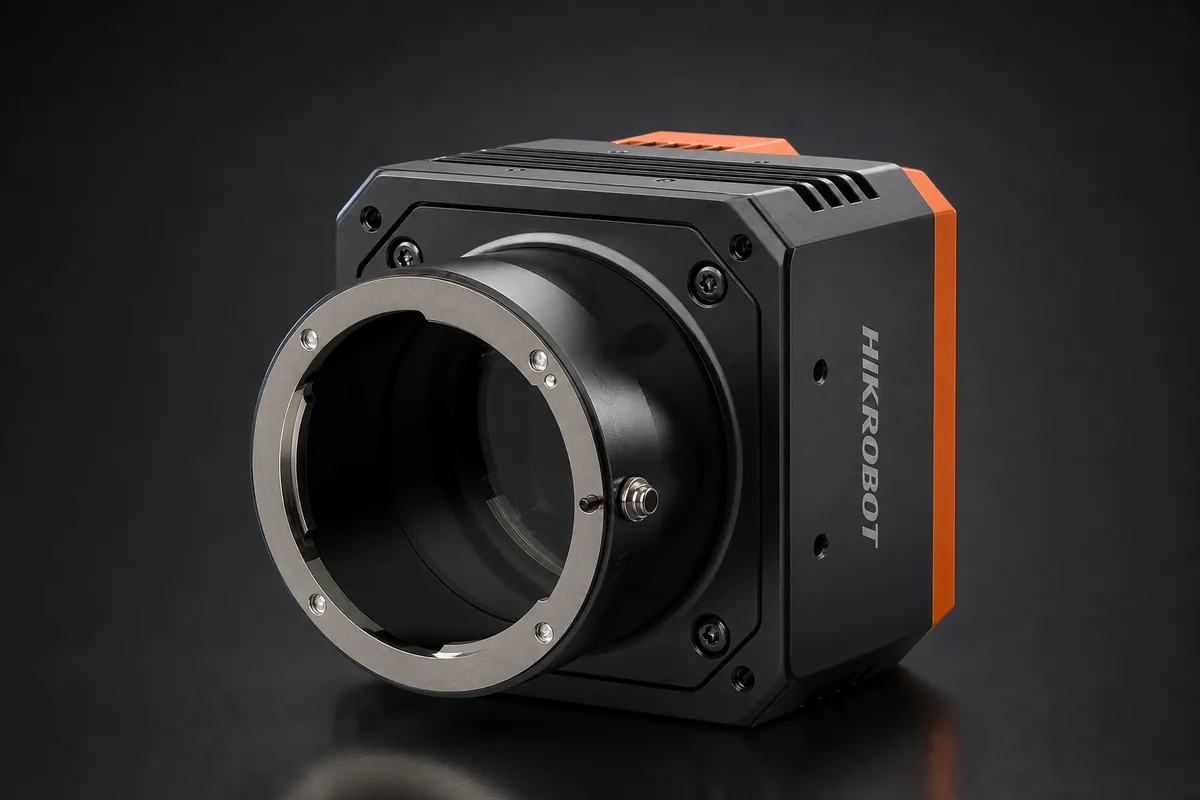
Resolution, modes and Camera Link position
Full-width 16384-pixel monochrome scanning with selectable row integration defines MV-CL162-91CM. The CMOS sensor is 16384 × 2 with 3.5 µm × 3.5 µm pixels. Camera Link supplies 10 kHz in Base, 20 kHz in Medium, 40 kHz in Full and 50 kHz in 80-bit mode. Binning raises the figures to 71 kHz for 1-line and 60 kHz for 2-TDI at full resolution, giving the camera distinct paths for normal transport and rate-focused operation.
ROI provides another rate option: 1-line capture reaches 120 kHz at 6820 resolution and below, while 2-TDI reaches 60 kHz at 13650 resolution and below. The link uses an SDR Camera Link connector, with a separate USB interface for firmware updates. Its M72*0.75 mount has a 12 mm flange back length and accepts F-mount lenses through an adapter. The body measures 76 mm × 76 mm × 42.1 mm, keeping the 16384-pixel device comparatively shallow.
MV-CL162-91CM is the Camera Link member among the 16384 × 2 monochrome choices. MV-CL162-91F1M transmits through a single LC fiber interface, runs at 73.2 kHz in standard 1-Line mode and reaches 120 kHz by ROI at 9984 pixels and below. MV-CL162-91F2M uses a 2LC connector with 1 Link or 2 Link transmission and a 73.2 kHz maximum. MV-CL162-B0F2M raises the 2LC fiber rate to 105 kHz while retaining 1-Line and 2-TDI modes.
Available versions
One device, different revisions. We ship the current one by default; if a specific revision is already installed on your line, name it in the request and we will match it.
| Part number | PN | Version | |
|---|---|---|---|
| MV-CL162-91CM discontinued | 306302189 | — | |
| MV-CL162-91CM V2.0 | 306303881 | V2.0 |
Specifications
| Sensor resolution | 16384×2 px |
| Maximum line rate | 10000 Hz @ Base, at full resolution 20000 Hz @ Medium, at full resolution 40000 Hz @ Full, at full resolution Show all (8)50000 Hz @ 80-bit (Deca), at full resolution71000 Hz @ at full resolution, 1-line, in binning mode 60000 Hz @ at full resolution, 2-line TDI, in binning mode 120000 Hz @ 1-line, in ROI mode, ROI width up to 6820 px 60000 Hz @ 2-line TDI, in ROI mode, ROI width up to 6820 px |
| Line/TDI image mode | single line, 2-TDI |
| Color mode | mono |
| Lens mount | M72×0.75 |
| Data interface | Camera Link |
| Sensor technology | CMOS |
| Pixel size | 3.5×3.5 µm |
| Dynamic range | 56.7 dB |
| Signal-to-noise ratio | 37 dB |
| Exposure time | 3…10000 µs |
| Auto exposure | Continuous, Off, Once, fixed exposure time, trigger width |
| Linear gain factor | 1 |
| Pixel format | Mono8, Mono10, Mono12 |
| Binning | 1x1, 1x2, 1x4, 2x1, 2x2, 2x4, 4x1, 4x2, 4x4 |
| Trigger mode | external, internal; line, frame, line and frame @ external trigger |
| Flange focal distance | 12 mm |
| Data interface connector | Camera Link SDR |
| Protocol compatibility | Camera Link, GenICam |
| Communication protocol versions | Camera Link 2.0 |
| Third party software protocol | Camera Link |
| Client software | MVS |
| Operating systems | Windows 7 (32/64-bit), Windows 10 (32/64-bit), Windows 11 (32/64-bit) |
| Digital I/O lines | 4 bidirectional lines, differential, single-ended, lines 0, 1, 3, 4 |
| Digital I/O connector | P10 12-pin |
| Power supply | 12…24 V |
| Power delivery | external power supply |
| Power consumption | 9.8 W (typical) @ supply voltage 12 V |
| Ingress protection | IP40 @ with lens and cables properly installed |
| Working temperature | -20…55 °C |
| Storage temperature | -30…80 °C |
| Humidity | 5…90 % @ non-condensing |
| Dimensions | 76×76×42.1 mm |
| Weight | 320 g (approx.) |
| Certification | CE, RoHS, KC |
| Camera Link configuration | Base, Medium, Full, 80-bit |
| Mounts via adapter | F-mount (via adapter) |
| Camera link control lines | CC1, CC2, CC3, CC4 |
| Pixel clock | 40000000 Hz; 66000000 Hz; 80000000 Hz; 85000000 Hz |
| Port inventory | Camera Link (data), USB (firmware update) |
| Power supply connector | P10 12-pin |
| Reverse image | horizontal |
| Tap count | 2; 4; 8; 10 |
| Tap geometry | 1X2, 1X4, 1X8, 1X10 |
Discontinued revisions — installed camera identification
MV-CL162-91CM · PN 306302189
| Auto exposure | Auto, Once, fixed exposure time, trigger width |
| Flange focal distance | 12 ±0.15 mm |
| Certification | CE, RoHS2.0, KC |
Selection and applications
16384-pixel Camera Link inspection. Binned monochrome line acquisition. ROI scanning at 120 kHz.
Minimum kit: Pair MV-CL162-91CM with an M72*0.75 lens or an adapted F-mount optic, an SDR Camera Link cable, and camera power provision for the installation.
Nearby in the range: MV-CL162-91F1M — Prefer it for a 16384 × 2 monochrome camera with an LC fiber interface; MV-CL162-91F2M — Prefer it when a 2LC fiber connector and 1 Link or 2 Link transmission are needed; MV-CL162-B0F2M — Prefer it for 16384 × 2 monochrome fiber capture at up to 105 kHz.
Cables and accessories for this model
Compatibility per manufacturer data.
- Data cables
- Camera Link
- Power
- Power
- Mounting
- Camera mounts
FAQ
How do Camera Link configurations set the MV-CL162-91CM base rates?
At full 16384-pixel width, the stated rates are 10 kHz in Base, 20 kHz in Medium, 40 kHz in Full and 50 kHz in 80-bit mode. The link is presented through an SDR connector.
What speed change does binning provide on MV-CL162-91CM?
With binning, the camera reaches 71 kHz in 1-line mode at full resolution and 60 kHz in 2-TDI mode at full resolution. These rates are higher than its listed 50 kHz maximum in 80-bit Camera Link operation.
Which ROI limits correspond to the highest MV-CL162-91CM rates?
ROI operation reaches 120 kHz in 1-line mode when resolution is 6820 or below. In 2-TDI mode, the stated ROI point is 60 kHz at a resolution of 13650 or below.
What lens mount and body depth does MV-CL162-91CM require?
The lens thread is M72*0.75 with a 12 mm flange back length, and F-mount optics are supported through an adapter. The body measures 76 mm × 76 mm × 42.1 mm.
How does MV-CL162-91CM differ from the fiber MV-CL162-91F1M?
Both are 16384 × 2 monochrome cameras with 3.5 µm pixels. MV-CL162-91CM uses Camera Link and offers binning and ROI rate figures, whereas MV-CL162-91F1M uses an LC fiber interface and lists standard and ROI rates.