Area camera · CT series
Hikrobot MV-CT0CU0060/R
- Lead time
- from 5 days
- Warranty
- 36 months
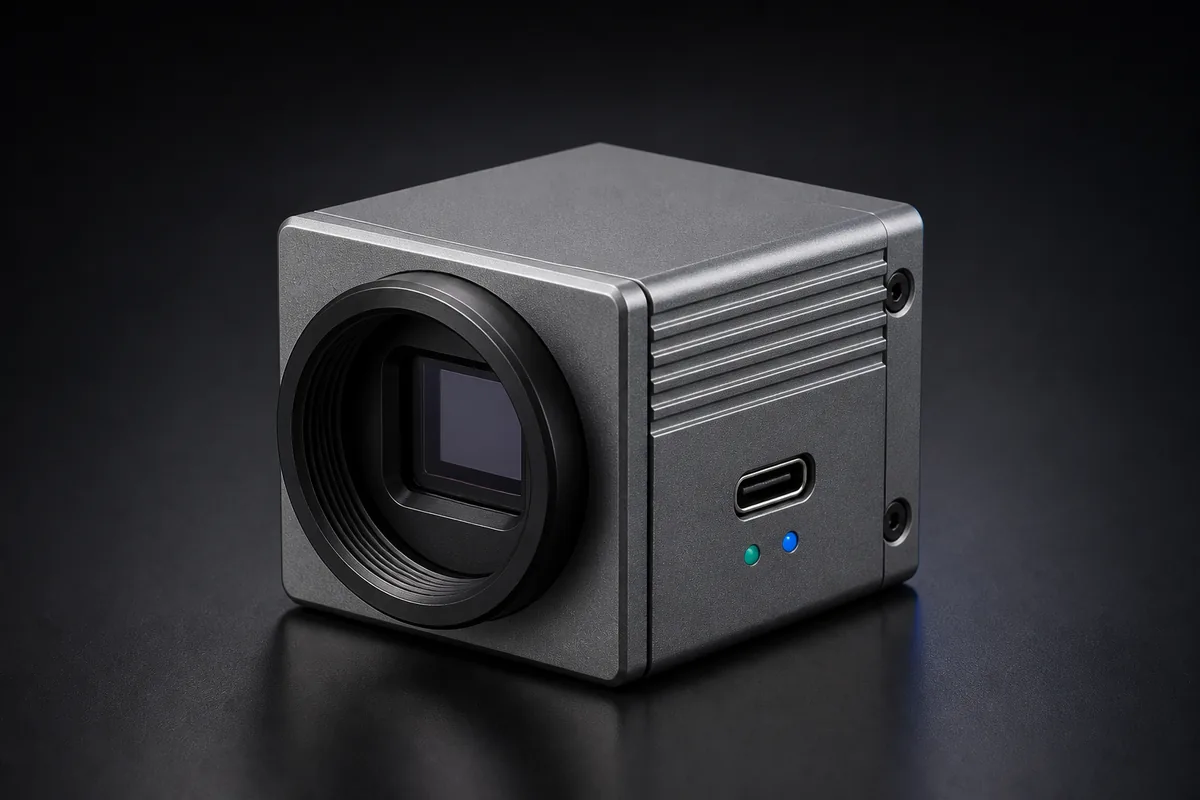
BASE version: what you get
What this version gives you:
- Type-C interface
- IP40 (under proper lens installation and wiring)
- Control interface not supported
Same version, other sensor variant:
Applications and positioning
A 6 MP Sony sensor and USB throughput shape this rolling-shutter camera. The Sony IMX178 CMOS device in MV-CT0CU0060/R outputs 3072 × 2048 px in colour at 60.9 fps. A rolling shutter, 2.4 × 2.4 µm pixel pitch and 1/1.8-inch sensor format define the optical side; USB 3.0 on the Type-C interface defines the data side.
The rolling shutter directs MV-CT0CU0060/R toward indexed surface review, strobed colour capture and fine-part inspection, where the scene remains stationary during sensor readout. Exposure extends through 8 µs to 1 s. Rolling and Global Reset modes add two readout choices. The 29 mm × 29 mm × 30 mm (1.1" × 1.1" × 1.2") body accepts C-mount optics. IP40 protection applies with proper lens installation and wiring, and the working range is –30 °C to 60 °C (–22 °F to 140 °F).
Its closest neighbours separate output type, transport and image scale. MV-CT0CG0060/R uses Gigabit Ethernet for 3072 × 2048 px colour capture at 19.5 fps. MV-CT0MG0060/R uses Gigabit Ethernet for 3072 × 2048 px monochrome capture at 19.5 fps. MV-CT0CU0050/G provides 2448 × 2048 px at 80 fps with a global-shutter colour path over USB 3.0. Retain MV-CT0CU0060/R when Color output, Type-C USB 3.0 and USB power are needed together at 60.9 fps.
Specifications
| Order code | MV-CT0CU0060/R/NN/NN |
| Product type | 6 MP USB 3.0 Area Scan Camera |
| Sensor type | CMOS, rolling shutter |
| Sensor model | Sony IMX178 |
| Sensor format | 1/1.8″ |
| Resolution | 3072 × 2048 px |
| Pixel size | 2.4 × 2.4 μm |
| Maximum frame rate | 60.9 fps @ 3072 × 2048 Bayer RG 8 |
| Mono color | Color |
| Pixel format | Mono 8, Bayer RG 8/10/10Packed/12/12Packed, YUV422Packed, YUV422_YUYV_Packed, RGB 8, BGR 8 |
| Binning | Supports 1 × 1, 2 × 2, 4 × 4 |
| Decimation | Supports 1 × 1, 2 × 2, 4 × 4 |
| Reverse image | Supports horizontal and vertical reverse image output |
| Dynamic range | 66.2 dB |
| Exposure time | 8 μs to 1 sec |
| Exposure mode | Off/Once/Continuous exposure mode, supports Rolling and Global Reset |
| Gain | 0 dB to 24 dB |
| SNR | 41.4 dB |
| Data interface | USB 3.0, compatible with USB 2.0 |
| Digital I/O | 8-pin M8 A-Code aviation connector provides power and I/O, including opto -isolated input × 1 (Line 0), opto-isolated output × 1 (Line 1), bi-directional non-isolated I/O × 1 (Line 2). |
| Lens mount | C-mount |
| Operating system | 32/64-bit Windows 7/10, 64-bit Windows 11, 32/64-bit Linux |
| Power supply | 9 VDC to 24 VDC, supports USB 3.0 power supply |
| Power consumption typ | Typ. 1.6 W @ 5 VDC (USB 3.0 provides power supply) |
| Ingress protection | IP40 (under proper lens installation and wiring) |
| Operating temperature | –30 °C to 60 °C (–22 °F to 140 °F) |
| Storage temperature | –30 °C to 80 °C (–22 °F to 176 °F) |
| Humidity | 20% RH to 95% RH (no condensation) |
| Dimensions | 29 mm × 29 mm × 30 mm (1.1″ × 1.1″ × 1.2″) |
| Weight | Approx. 72 g (0.2 lb.) |
| Certification | CE, RoHS, KC |
| Compatibility | USB3 Vision, GenICam |
| Data interface connector | Type-C interface |
| Control interface | Not supported |
| Client software | MVS or third-party software meeting with USB3 Vision Protocol |
Selection and applications
Colour feature capture at 3072 × 2048 px. Stationary colour inspection with a rolling shutter. Full-frame acquisition up to 60.9 fps.
| Lenses | MVL-KF1628M-12MP, MVL-KF5024M-25MP |
|---|
Minimum kit: Use MV-CT0CU0060/R with a C-mount lens, a USB 3.0 cable to the Type-C interface, and either USB bus power or 9 V DC to 24 V DC power through the 8-pin M8 A-Code connection.
Nearby in the range: MV-CT0CG0060/R — Prefer it for Gigabit Ethernet transport at 3072 × 2048 px and 19.5 fps.; MV-CT0MG0060/R — Prefer it for Mono output over Gigabit Ethernet at 3072 × 2048 px and 19.5 fps.; MV-CT0CU0050/G — Prefer it for 2448 × 2048 px, 80 fps and global-shutter colour capture..
Compatible lens options
- MVL-KF1628M-12MP — C-mount mount; Ø17.6 mm image circle fully covers the 1/1.8 sensor; 12 MP optical class — headroom for this camera
- MVL-KF5024M-25MP — C-mount mount; Ø19.3 mm image circle fully covers the 1/1.8 sensor; 25 MP optical class — headroom for this camera
Cables and accessories for this model
Compatibility per manufacturer data.
- Data cables
- CT: USB Type-CUSB 3.0
- I/O & power cables
- CT: power and I/O
- Power
- Power
- Mounting
- Camera mounts
FAQ
Which suggested lenses cover the sensor in MV-CT0CU0060/R?
For MV-CT0CU0060/R, the C-mount matches are MVL-KF1628M-12MP and MVL-KF5024M-25MP. Their image circles cover the 1/1.8-inch sensor, and the 12 MP and 25 MP lens classes are above the camera’s 3072 × 2048 px matrix. Both therefore match the stated mount, sensor coverage and resolution requirement.
How should power and cabling be arranged for MV-CT0CU0060/R?
The Type-C USB 3.0 connection supports bus power, while the camera also accepts 9 V DC to 24 V DC. The 8-pin M8 A-Code connection provides power and I/O for externally powered wiring. Consumption is typically 1.6 W at 5 V DC (USB 3.0 provides power supply).
What data interface and peak acquisition rate does MV-CT0CU0060/R provide?
Data uses USB 3.0 through the Type-C interface and is compatible with USB 2.0. The stated full-frame ceiling is 60.9 fps at 3072 × 2048 Bayer RG 8. MVS and software meeting the USB3 Vision protocol are supported for acquisition.
How do shutter timing and exposure affect motion work with MV-CT0CU0060/R?
This is a rolling-shutter CMOS camera, so stationary or strobed scenes suit geometry-sensitive work. It reaches 60.9 fps, with exposure from 8 µs to 1 s. Rolling and Global Reset are supported. Exposure operation includes Off, Once and Continuous.
Which image-reduction and I/O functions are available on MV-CT0CU0060/R?
Binning and decimation each support 1 × 1, 2 × 2 and 4 × 4 operation. Horizontal and vertical reverse-image output is available. The 8-pin M8 A-Code I/O provides one opto-isolated input, one opto-isolated output and one bidirectional non-isolated line for sequencing.
What enclosure conditions and temperature range apply to MV-CT0CU0060/R?
Operation is rated from –30 °C to 60 °C (–22 °F to 140 °F), with 20% RH to 95% RH (no condensation). The housing is 29 mm × 29 mm × 30 mm (1.1" × 1.1" × 1.2") and weighs approximately 72 g (0.2 lb.). Its IP40 rating applies under proper lens installation and wiring, so the station must provide conditions consistent with that protection level.