MVisionPro Engineering Library · guide
Choosing a lens when the working distance is fixed
In short
Decide in this order: the field on one named axis, the active sensor size from the camera record, the focal length the calculator returns, then a published lens whose image circle, focusing range and mount all fit. Settle the reference point before you calculate: the working distance runs from the lens principal plane rather than from a housing, so check the candidate lens documentation for it, or send us the part number and we will establish it. One step is then obligatory: the catalog lens is shorter than the calculated focal length, so the field it gives at your distance is wider than requested, and you have to recompute the sampling, the pixels the sensor puts on each millimetre of the part, for that real pair. If that sampling is too low for the feature you must see, change the camera, the distance or the optical family rather than the lens alone.
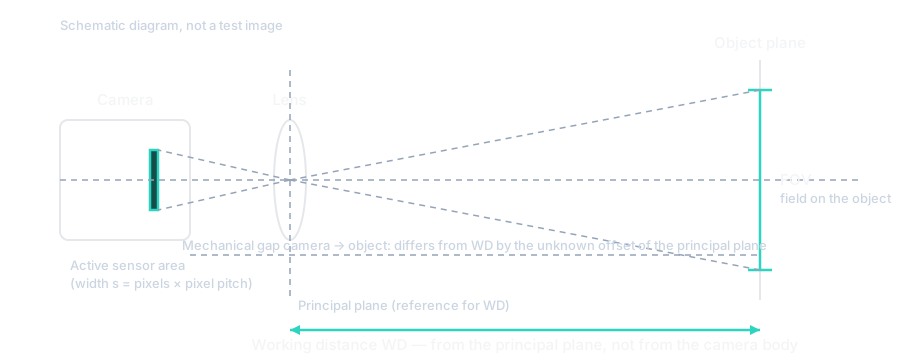
Decide in this order when the distance is fixed
Start with the distance. The working distance here is measured from the lens principal plane, the optical reference plane the thin-lens relation uses, while the machine drawing gives a mechanical gap between housings. Reconcile the two against the documentation of the lens you intend to use, or ask us for the reference point of that part number. The 500 mm below is an assumption about the optical distance.
Name the axis next. The field of view is the width and height the sensor captures on the object, and the calculation is consistent only when the sensor size and the field share an axis. Enter the field the machine really has to see, including the part's position spread.
Take the active sensor size from the camera record rather than from the optical format label, which names a size class and not a measurement in inches. The active sensor size is the width and height of the pixel array, and the two cameras below use the same 3.45 µm pixels (datasheet) yet differ by more than a millimetre in width.
Then run the calculation. The tool returns the magnification, the sensor size divided by the field it covers, the exact focal length and the nearest catalog nominal below it; the derivation and its limits are on the field of view reference page. It rounds down because a longer lens narrows the field and clips the part.
Finish on the pair you will buy. The tool returns the field that nominal gives at your distance and the sampling with it; compare that sampling with the task before accepting the wider field.
Three checks the focal length does not cover
The image circle is the illuminated circle the lens projects, and it has to cover the sensor diagonal. A Ø9 mm circle (datasheet) covers the 8.93 mm reference diagonal of the 1/1.8″ format (datasheet) and does not reach a 2/3″ sensor. When the two sit within a hundredth of a millimetre, as a Ø11 mm circle does against an active diagonal of 11.0114 mm (calculated), nothing is settled either way: the circle tolerance and corner performance decide it, and both come from the lens datasheet or a sample image.
The focusing range has to contain your distance. Fixed-focal lenses declare a minimum object distance, the nearest distance at which they are specified to focus; large-format lenses also declare a far limit, so LF9040M-M72 at 722–1229 mm (datasheet) cannot work at a fixed 500 mm.
The mount has to match the camera. Both 25 mm candidates below are C-mount (datasheet), while an M72 × 0.75 thread is a mechanical interface question rather than a swap.
What to change when the field does not fit
Four levers remain once the distance is frozen. Accept the wider field of the next shorter published lens when its sampling still meets the task and no fixture enters the frame. Change the camera: a larger active sensor needs a longer focal length at the same field and distance, and more pixels across the field raise the sampling. Change the working distance when the envelope allows, using the distance the tool reports for that nominal lens. Move to another optical family, selected on published coverage and focusing data rather than the nominal focal length alone.
Cropping answers a different question: it removes unwanted parts of an image already captured, and it does not recover pixels per millimetre lost to a wider field, narrow the optical field, or fix an undersized image circle.
When a telecentric lens is the answer instead
A telecentric lens is chosen for controlled magnification and perspective, and the compact variants are specified by magnification and a fixed working distance rather than focal length. You match the machine to a variant's stated working distance, then check its depth of field, the range of part positions along the axis that stays acceptably sharp: MVL-HY-05-510C states 0.5× at 510 mm with 4.5 mm (datasheet). Magnification also fixes the field: at 0.5× it is twice the sensor width, far short of the 120 mm here, so these lenses answer perspective error rather than a wide field.
Worked example: 120 mm at a fixed 500 mm on two cameras
The machine holds the optical distance at 500 mm and the part needs a 120 mm wide field, both assumptions of this example; the height follows each sensor's aspect ratio.
| Step | MV-CA032-10GM (1/1.8″) | MV-CA050-12UM (2/3″) | Origin |
|---|---|---|---|
| Active sensor | 7.0656 × 5.2992 mm, 2048 × 1536 px at 3.45 µm | 8.4456 × 7.0656 mm, 2448 × 2048 px at 3.45 µm | calculated from datasheet |
| Requested field | 120 × 90 mm | 120 × 100.3922 mm | assumption |
| Calculated focal length | 27.80296 mm | 32.87617 mm | calculated |
| Catalog nominal, rounded down | 25 mm | 30 mm | calculated |
| Sampling at requested field | 17.0667 px/mm | 20.4 px/mm | calculated |
| Field of a 25 mm lens at 500 mm | 134.2464 × 100.6848 mm | 160.4664 × 134.2464 mm | calculated |
| Sampling of the installed pair | 15.25553 px/mm | 15.25553 px/mm | calculated |
For the 1/1.8″ camera a 25 mm lens gives 134.2464 mm of width at 500 mm (calculated), 14.25 mm more than requested, and MVL-HF2528M-6MPE publishes that focal length with a Ø9 mm image circle, C-mount and a 0.2 m minimum object distance (datasheet), covering the format and focusing well inside 500 mm. Going longer fails: a 30 mm lens would need 539.5109 mm (calculated) for 120 mm.
The 2/3″ camera shows why a nominal is not yet a lens. The 30 mm the tool reports comes from the series of standard focal lengths. The catalog carries 30 mm in the 1/1.8″ set, whose Ø9 mm circle is too small for this sensor, and as the large-format MVL-LF3040M-005-M72, Φ58 mm circle, M72 × 0.75 mount, 205–1000 mm range (datasheet), an interface decision rather than a swap. The choice steps down to 25 mm in the 2/3″ category, where the field at 500 mm becomes 160.4664 mm (calculated), 40 mm wider than requested. The candidate there is MVL-MF2528M-8MP, whose record reads 25 mm, F2.8–F16, Ø11 mm image circle, C-mount, 0.1 m (datasheet); send us that part number and we confirm coverage and corner performance.
The last two rows carry the comparison people get wrong. At the common 120 mm requirement the 2/3″ camera samples more finely, 20.4 against 17.0667 px/mm (calculated), but that compares requirements, not installed systems. With a real 25 mm lens at 500 mm both give 15.25553 px/mm and 65.55 µm per object pixel (calculated), because both use 3.45 µm pixels in the same geometry and the wider field spreads the same pixels over more millimetres of the scene. Check that figure against the smallest feature you must see.
Calculate for your case
The link carries everything this decision needs: camera, both field axes and working distance travel in the address, so nothing is typed by hand. Open the 1/1.8″ case or the 2/3″ case and replace the camera, the field values and the distance with your own.
The address also sets the page's feature-size fields to 0.1 mm and 5 px and the speed to 0 mm/s, which belong to other questions. For the installed pair, run the tool again with the field the chosen lens gives, 134.2464 × 100.6848 mm or 160.4664 × 134.2464 mm here.
Equipment that fits this example
MVL-HF2528M-6MPE is the 25 mm lens for the 1/1.8″ camera: Ø9 mm image circle, C-mount, minimum object distance 0.2 m (datasheet). Other 25 mm variants in the 1/1.8″ and 2/3″ categories differ in aperture, image circle and minimum object distance. Send us the part number and we confirm the variant against its datasheet.
Common mistakes
- A machine drawing measures between housings; the calculation measures from the principal plane. Reconcile the two reference points before you enter a number, and where the offset is unknown, treat the result as preliminary until the lens documentation settles it.
- Take the nominal focal length to the catalog before you order, because it is a value in a series and not a part number. Confirm the image circle, the focusing range and the mount from the record of the exact variant, not from a family-level range.
- Watch what the wider field costs. A shorter lens takes pixels off the part, so recompute the sampling for the installed pair and compare it with the smallest feature you must resolve.
- An equal focal length in another family is not automatically a fit. Check the mount and the format first: a 30 mm large-format lens with an M72 × 0.75 thread is a different mechanical interface.
When this rule breaks
The calculation is a thin-lens model and returns a value for selection rather than a drawing. It sets the field, the focal length and the sampling, and says nothing about how the lens resolves a feature at the frame edge or how much distortion it adds to a measurement; those come from the lens datasheet and a sample image of your part.
The order itself breaks in one case: when the field you need is far wider than any published focal length reaches at your distance, the distance, the camera or the number of cameras has to change, and the calculation shows which of the three works.
Next step
Send us the camera model or the active sensor size, the field you need on a named axis, and the distance your machine holds. We recalculate against the catalog, check the image circle, the focusing range and the mount on the exact variant, and say plainly when the geometry does not close.
Sources
- MVisionPro engineering calculator and Hikrobot catalog records (datasheet fields); calculations, the tool page and the public API were verified on 2026-09-19
Related
How this material was prepared
Prepared with MVisionPro AI agents from stated sources and the calculation core; MVisionPro retains editorial responsibility. A physical test or human engineering review is claimed only when explicitly stated. Read the editorial method.
Editorial status: verified. Content updated 2026-09-19.