Area camera · CA series
Hikrobot MV-CA013-20GC
The manufacturer is transitioning this series to newer line-ups. The model is on the current price list — an engineer will confirm availability, lead time and the current successor in the first reply.
- Lead time
- from 5 days
- Warranty
- 36 months
Resolution and speed on the network
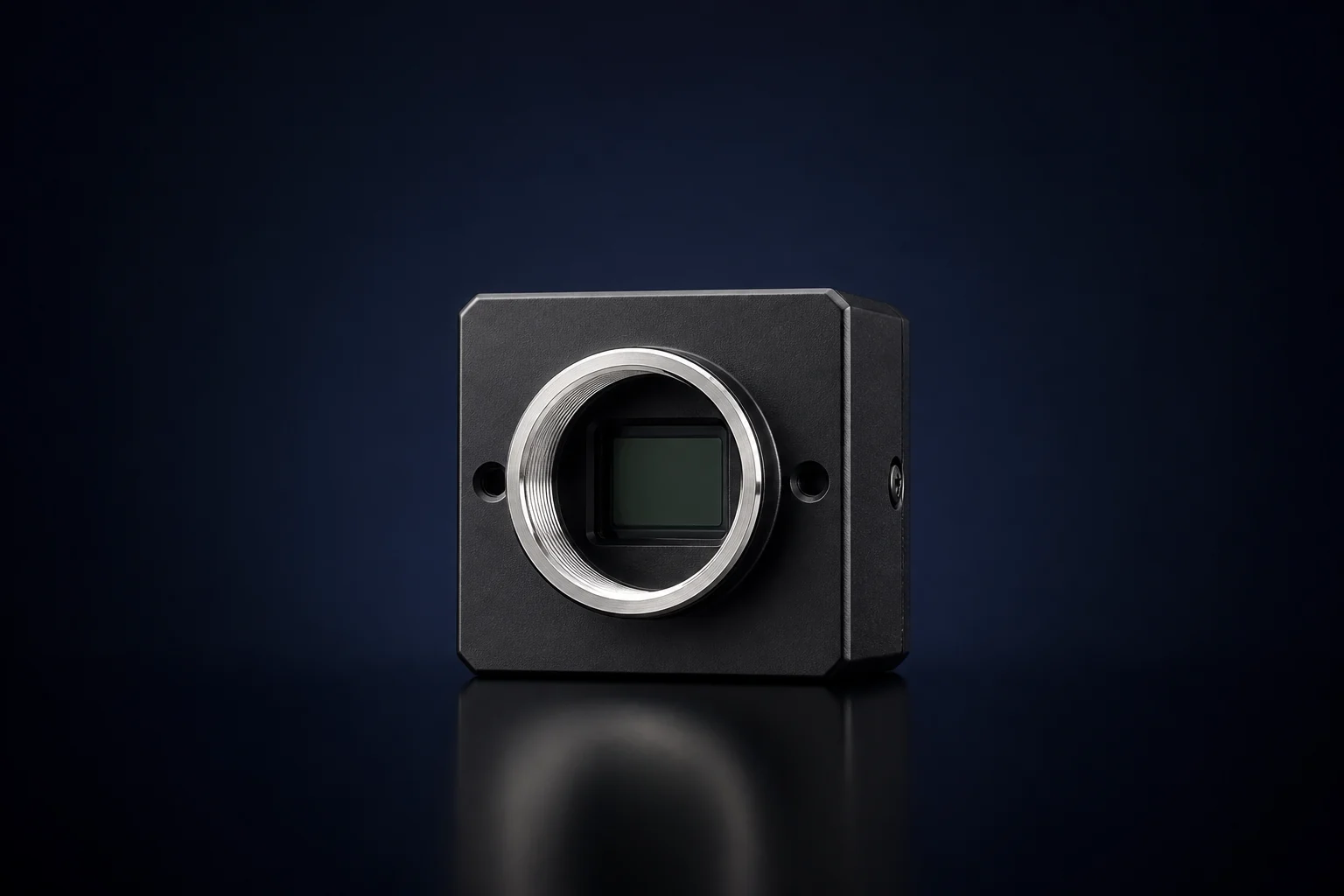
A 1280 × 1024 frame at 90 fps gives MV-CA013-20GC more spatial sampling than the sub-megapixel high-speed models while retaining motion-capable global exposure. The 1/2-inch OnSemi PYTHON1300 CMOS sensor sends images through Gigabit Ethernet. A C-mount, 29 × 29 × 42 mm body and 12 V DC or PoE supply support a compact networked camera head.
The resolution and rate suit moving-part presence, alignment and shape checks where 672 × 512 or 720 × 540 would provide too few samples. A global shutter aligns the exposure across the image, and 90 fps provides repeated observations during motion. The camera draws a typical 2.7 W, offers GigE Vision V2.0 and GenICam, and operates from 0 to 50 °C. Its enclosure rating is IP30.
Choose MV-CA013-20GC for 1280 × 1024 over Gigabit Ethernet at 90 fps. MV-CA013-21UM uses the PYTHON1300 for mono USB 3.0 capture at 210 fps. MV-CA013-A0GC keeps 1280 × 1024 and a network link, explicitly provides color, and reaches 92.8 fps. MV-CA004-10GC V3.0 is the faster color-network option at 312.9 fps, but its frame is 720 × 540.
Specifications
| Shutter | global |
| Sensor model | OnSemi PYTHON1300 |
| Nominal optical sensor format | 1/2″ |
| Sensor resolution | 1280×1024 px |
| Maximum frame rate | 90 fps @ resolution 1280×1024 px |
| Color mode | color |
| Lens mount | C-mount |
| Data interface | GigE (Fast Ethernet compatible) |
| Sensor technology | CMOS |
| Pixel size | 4.8×4.8 µm |
| Dynamic range | 59.6 dB |
| Signal-to-noise ratio | 39.8 dB |
| Exposure time | 62…10000000 µs |
| Auto exposure | Off, Once, Continuous |
| Gain | 0…15 dB |
| Pixel format | Mono8, Mono10, Mono12, BayerRG8, BayerRG10, BayerRG10p, BayerRG12, BayerRG12p, YUV422Packed, YUV422_YUYV_Packed, RGB8 |
| Binning | 1x1, 1x2, 2x1, 1x4, 4x1, 2x2, 2x4, 4x2, 4x4 |
| Decimation | 1x1, 2x2 |
| Image buffer | 128 MB |
| Protocol compatibility | GigE Vision, GenICam |
| Communication protocol versions | GigE Vision 2.0 |
| Third party software protocol | GigE Vision |
| Client software | MVS |
| Operating systems | Windows 7 (32/64-bit), Windows 10 (32/64-bit), Linux (32/64-bit) |
| Digital I/O lines | 1 input, opto-isolated, line 0; 1 output, opto-isolated, line 1; 1 bidirectional line, non-isolated, line 2 |
| Power supply | 12 V |
| Power delivery | PoE |
| PoE support | yes |
| Power consumption | 2.7 W (typical) @ DC, supply voltage 12 V |
| Ingress protection | IP30 |
| Working temperature | 0…50 °C |
| Storage temperature | -30…70 °C |
| Humidity | 20…80 % |
| Dimensions | 29×29×42 mm |
| Weight | 68 g (approx.) |
| Certification | CE, RoHS, KC |
| Reverse image | horizontal, vertical |
Documents
Engineering data for this model
Calculated by the MVisionPro engineering tools from the passport data of this model for typical tasks. The figures are estimates for preliminary selection.
Engineering conclusion: 16 mm at 300 mm WD gives a 109.06 mm field, so a 100 mm object fits geometrically. The confirmed mode 1280 × 1024 px · 90 fps · BayerRG8 gives a raw stream of 0.944 Gbit/s over GigE.
Note: Spatial sampling is an engineering estimate; confirm measurement performance by calibration and verify the selected lens installation.
Field of view with a standard lens
| Task | Standard lens | Field of view at the task distance | Distance for the exact field |
|---|---|---|---|
| 100 mm object at 300 mm | 16 mm | 109.06 mm | 276.42 mm |
| 200 mm object at 500 mm | 14.8 mm | 201.42 mm | 496.57 mm |
Resolution on the object
| Requested field of view | Sampling density | Object pixel | Minimum defect (5 px) |
|---|---|---|---|
| 100 mm | 12.8 px/mm | 78.13 µm/px | 0.3906 mm |
| 200 mm | 6.4 px/mm | 156.25 µm/px | 0.7813 mm |
Depth of field and motion
| Requested field of view | Depth of field | Exposure limit (1 px blur) |
|---|---|---|
| 100 mm | 21.6 mm at f/4 | 156.3 µs at 500 mm/s |
| 200 mm | 83.88 mm at f/4 | 156.3 µs at 1000 mm/s |
Data stream by interface
| Confirmed mode | Passport condition | Interface | Raw stream per camera |
|---|---|---|---|
| 1280 × 1024 px · 90 fps · BayerRG8 | 90 fps @1280 × 1024 | GigE | 0.944 Gbit/s |
Compatible lenses and cables
| Type | Model | What was checked |
|---|---|---|
| Lens | MVL-HF1628M-6MPE | Mount, sensor coverage and the optical task of the scenario |
| Lens | MVL-KF1628M-12MP | Mount, sensor coverage and the optical task of the scenario |
| Lens | MVL-KF1628M-12MPE | Mount, sensor coverage and the optical task of the scenario |
| Cable | MV-ACC-01-1101-5m | Data role, interface family, connector path and 5 m length |
| Cable | MV-ACG-RJ45s(up)-RJ45-HF-5m | Data role, interface family, connector path and 5 m length |
| Cable | MV-ACG-RJ45s(up)-RJ45-ST-5m | Data role, interface family, connector path and 5 m length |
| Cable | MV-ACG-RJ45s-RJ45-HF-5m | Data role, interface family, connector path and 5 m length |
How these figures were calculated
- Assumption: Thin-lens approximation; working distance is measured from the principal plane.
- Assumption: The primary optical calculation uses the sensor width and field-of-view width.
- Assumption: The standard focal length is selected downward and its actual field of view is checked.
- Assumption: Object-space resolution is calculated independently for each requested axis.
- Assumption: Motion speed is constant along the selected motion axis.
- Assumption: Depth of field uses a two-pixel circle of confusion.
- Assumption: Stream bandwidth uses the confirmed wire bits per pixel before protocol overhead.
- Assumption: A selected camera is checked only against its passport interface profile.
- Warning: The passport frame rate is tied to the stated mode conditions.
Engineering tools
Configure a kit · Check interface · Calculate optics for this camera
Guide: Choosing a lens when the working distance is fixed · Exposure, motion blur and strobe
Selection and applications
Moving-part alignment checks. Shape inspection at 1280 × 1024. Networked presence verification.
Minimum kit: Combine the camera with a C-mount lens, a Gigabit Ethernet cable, and either PoE or a 12 V DC supply.
Nearby in the range: MV-CA013-21UM — Prefer mono USB 3.0 capture at 1280 × 1024 and up to 210 fps; MV-CA013-A0GC — Prefer explicit color output over Gigabit Ethernet at 1280 × 1024 and 92.8 fps; MV-CA004-10GC V3.0 — Prefer color 312.9 fps network capture when 720 × 540 is sufficient.
Cables and accessories for this model
Compatibility per manufacturer data.
- Data cables
- GigE
- Power
- Power
- Mounting
- Camera mounts
FAQ
What inspection scale fits the resolution and frame rate?
The camera records 1280 × 1024 at up to 90 fps with a global-shutter OnSemi PYTHON1300. This pairing supports repeated shape, alignment and presence observations on moving items when more image samples are needed than a 720 × 540 camera provides.
Can the Gigabit Ethernet cable also provide camera power?
Yes. The data connection is Gigabit Ethernet and the power entry specifies 12 V DC with PoE support. Typical consumption is 2.7 W, so a powered network connection can combine data and power, or the camera can use the separate 12 V DC route.
Which C-mount lens format matches the PYTHON1300 sensor?
MV-CA013-20GC uses a C-mount in front of a 1/2-inch PYTHON1300 sensor. The lens should therefore be a C-mount type with image-circle coverage for the 1/2-inch format; focal length should follow the required scene coverage and mounting distance.
How does the USB mono neighbour change capture speed?
MV-CA013-21UM uses a PYTHON1300 sensor at the same 1280 × 1024 resolution, but it is mono and transfers over USB 3.0 at up to 210 fps. MV-CA013-20GC instead uses Gigabit Ethernet and reaches 90 fps.
What housing and ambient limits apply to deployment?
The body measures 29 × 29 × 42 mm, weighs 68 g and is rated IP30. Its documented working range is 0 to 50 °C at 20–80% RH. These figures set the mounting, enclosure and thermal conditions for the networked camera.