Area camera · CA Series
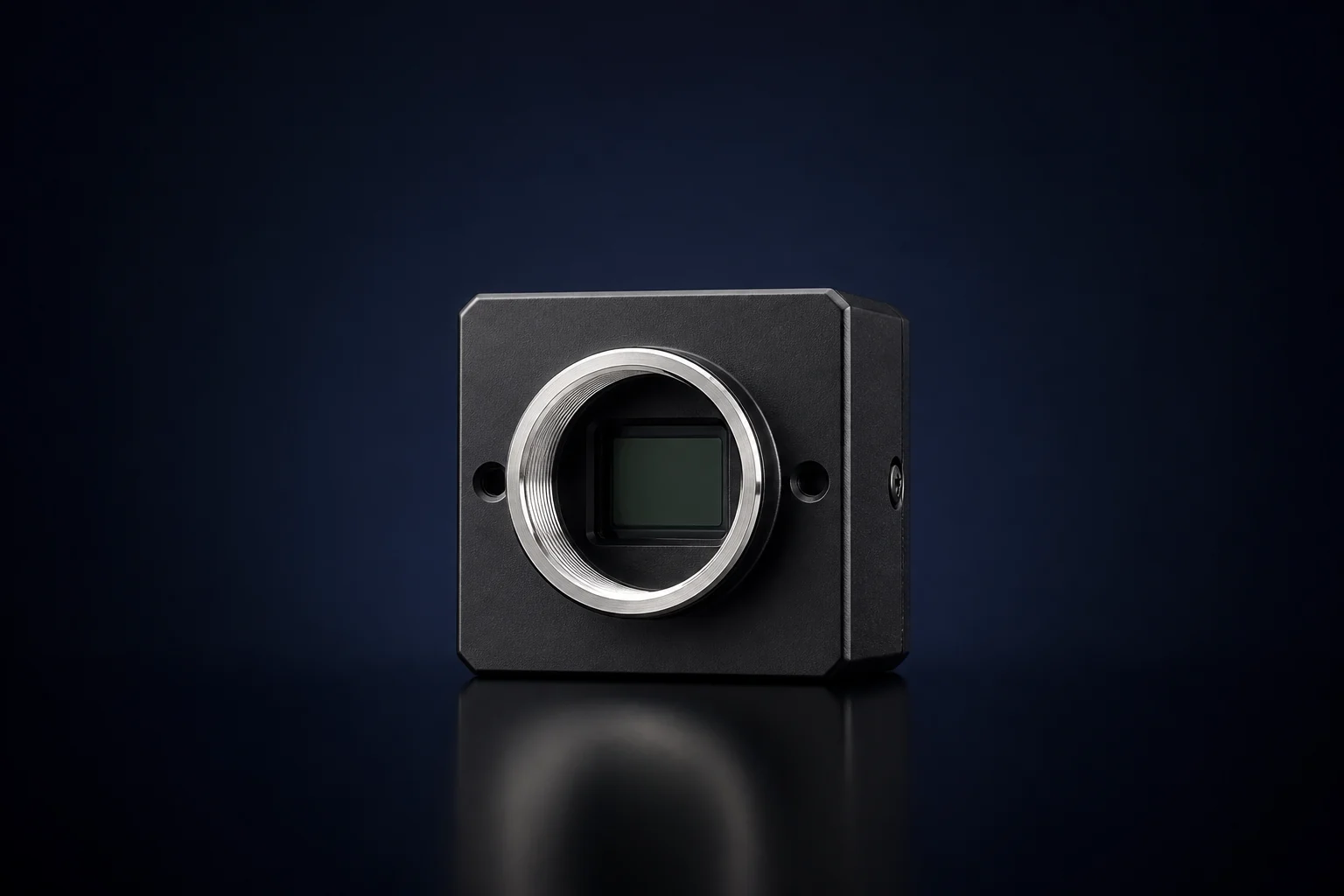
Hikrobot MV-CA060-10GC
- Lead time
- from 5 days
- Warranty
- 36 months
Discontinued
The manufacturer has discontinued this model.
Last buy date at the manufacturer: 2025-12-30.
Manufacturer-listed replacement:
Color imaging and range context
Color detail rather than motion speed is the central role of MV-CA060-10GC. The camera uses a Sony IMX178 CMOS sensor with a 1/1.8-inch format, 2.4 µm pixels and rolling shutter to produce 3072 × 2048 images at 17 fps. Gigabit Ethernet connects the 29 mm × 29 mm × 42 mm C-mount body, and either 12 V DC or PoE can supply power.
The 6.3 MP color frame suits component identification, assembly verification and surface documentation when the part is stationary or indexed during exposure. Holding the object still avoids rolling-shutter geometry changes, while the 27 µs to 2.5 sec exposure range accommodates brief illuminated captures and slower static scenes. A 6-pin Hirose connector provides isolated input and output plus a bidirectional line for coordinating the capture with the machine.
MV-CA060-11GM shares the Sony IMX178, 3072 × 2048 resolution, 17 fps Gigabit Ethernet link and rolling shutter, but supplies monochrome images for intensity and edge analysis. MV-CB060-10GC-S keeps the color IMX178 and GigE interface in a shorter 30.2 mm body, reaches 19.1 fps and offers C-mount or M12-mount optics. Select MV-CA060-10GC when color information, PoE and the enclosed CA form are the required combination.
Specifications
| Product type | 6.3 MP GigE Area Scan Camera |
| Sensor type | CMOS, rolling shutter |
| Sensor model | Sony® IMX178 |
| Sensor format | 1/1.8″ |
| Resolution | 3072 × 2048 |
| Pixel size | 2.4 μm × 2.4 μm |
| Maximum frame rate | 17 fps @ 3072 × 2048 |
| Mono color | Color |
| Dynamic range | 71.3 dB |
| Exposure time | 27 μs to 2.5 sec |
| Gain | 0 dB to 20 dB |
| Data interface | Gigabit Ethernet, compatible with Fast Ethernet |
| Digital I/O | 6-pin Hirose connector provides power and I/O, including opto -isolated input × 1 (Line 0), opto-isolated output × 1 (Line 1), bi-directional non-isolated I/O × 1 (Line 2). |
| Lens mount | C-mount |
| Power supply | 12 VDC, supports PoE |
| Power consumption | Typ. 3.5 W @ 12 VDC |
| Ingress protection | IP30 (under proper lens installation and wiring) |
| Operating temperature | 0 °C to 50 °C (32 °F to 122 °F) |
| Storage temperature | –30 °C to 70 °C (–22 °F to 158 °F) |
| Humidity | 20% RH to 80% RH (no condensation) |
| Dimensions | 29 mm × 29 mm × 42 mm (1.1″ × 1.1″ × 1.7″) |
| Weight | Approx. 68 g (0.15 lb.) |
| Certification | CE-EMC, KC, UL, FCC-SDoC |
| Compatibility | GigE Vision V1.2, GenICam |
Engineering data for this model
Calculated by the MVisionPro engineering tools from the passport data of this model for typical tasks. The figures are estimates for preliminary selection.
Engineering conclusion: 20 mm at 300 mm WD gives a 103.22 mm field, so a 100 mm object fits geometrically. The confirmed mode 3072 × 2048 px · 17 fps · BayerRG8 gives a raw stream of 0.856 Gbit/s over GigE, which fits one link.
Note: Spatial sampling is an engineering estimate; confirm measurement performance by calibration and verify the selected lens installation.
Field of view with a standard lens
| Task | Standard lens | Field of view at the task distance | Distance for the exact field |
|---|---|---|---|
| 100 mm object at 300 mm | 20 mm | 103.22 mm | 291.27 mm |
| 200 mm object at 500 mm | 16 mm | 223.03 mm | 450.03 mm |
Resolution on the object
| Field of view | Sampling density | Object pixel | Minimum defect (5 px) |
|---|---|---|---|
| 103.22 mm | 30.72 px/mm | 32.55 µm/px | 0.1628 mm |
| 223.03 mm | 15.36 px/mm | 65.1 µm/px | 0.3255 mm |
Depth of field and motion
| Field of view | Depth of field | Exposure limit (1 px blur) |
|---|---|---|
| 103.22 mm | 7.59 mm at f/4 | 65.1 µs at 500 mm/s |
| 223.03 mm | 29.3 mm at f/4 | 65.1 µs at 1000 mm/s |
Data stream by interface
| Confirmed mode | Passport condition | Interface | Raw stream per camera |
|---|---|---|---|
| 3072 × 2048 px · 17 fps · BayerRG8 | 17 fps @ 3072 × 2048 | GigE | 0.856 Gbit/s |
Compatible lenses and cables
| Type | Model | What was checked |
|---|---|---|
| Lens | MVL-HF0824M-10MP | Mount, sensor coverage and the optical task of the scenario |
| Lens | MVL-KF0814M-12MPE | Mount, sensor coverage and the optical task of the scenario |
| Lens | MVL-KF0818M-12MP | Mount, sensor coverage and the optical task of the scenario |
| Lens | MVL-KF1228M-12MP | Mount, sensor coverage and the optical task of the scenario |
| Lens | MVL-KF1628M-12MP | Mount, sensor coverage and the optical task of the scenario |
| Lens | MVL-KF1628M-12MPE | Mount, sensor coverage and the optical task of the scenario |
| Cable | MV-ACC-01-1101-5m | Data role, interface family, connector path and 5 m length |
| Cable | MV-ACG-RJ45s(up)-RJ45-HF-5m | Data role, interface family, connector path and 5 m length |
| Cable | MV-ACG-RJ45s(up)-RJ45-ST-5m | Data role, interface family, connector path and 5 m length |
| Cable | MV-ACG-RJ45s-RJ45-HF-5m | Data role, interface family, connector path and 5 m length |
How these figures were calculated
- Assumption: Thin-lens approximation; working distance is measured from the principal plane.
- Assumption: The primary optical calculation uses the sensor width and field-of-view width.
- Assumption: The standard focal length is selected downward and its actual field of view is checked.
- Assumption: Object-space resolution is calculated independently for each requested axis.
- Assumption: Motion speed is constant along the selected motion axis.
- Assumption: Depth of field uses a two-pixel circle of confusion.
- Assumption: Stream bandwidth uses the confirmed wire bits per pixel before protocol overhead.
- Assumption: A selected camera is checked only against its passport interface profile.
- Warning: The passport frame rate is tied to the stated mode conditions.
Engineering tools
Configure a kit · Check interface · Calculate optics for this camera
Selection and applications
Color verification of stationary assemblies. Detailed surface documentation at 3072 × 2048. Indexed component inspection over Gigabit Ethernet.
Minimum kit: MV-CA060-10GC, a 1/1.8-inch C-mount lens, a Gigabit Ethernet cable, and either PoE or a 12 V DC supply are sufficient for basic image acquisition.
Nearby in the range: MV-CA060-11GM — Prefer it when the 3072 × 2048 result can be monochrome.; MV-CB060-10GC-S — Prefer it for C-mount or M12-mount integration at 19.1 fps..
Cables and accessories for this model
Compatibility per manufacturer data.
- Data cables
- GigE
- I/O & power cables
- Hirose 6-pin IO
- Power
- Power
- Mounting
- Camera mounts
FAQ
Which lens mount and image format does MV-CA060-10GC use?
The camera has a C-mount and a 1/1.8-inch Sony IMX178 sensor. A lens should cover that sensor format and resolve the 3072 × 2048 array with its 2.4 µm pixels, especially when detail near the field edges matters.
Can MV-CA060-10GC data and power share the Ethernet connection?
Yes. MV-CA060-10GC supports PoE, as well as direct 12 V DC power. Typical consumption is 3.5 W at 12 V DC, so a PoE-capable network path can reduce the separate wiring needed at the camera position.
When is the rolling shutter appropriate on this color model?
It is appropriate when the inspected part is stationary, indexed or otherwise held during the exposure. The Sony IMX178 reads with a rolling shutter, so uncontrolled motion can change feature geometry between rows even though the maximum rate is 17 fps.
What acquisition rate and exposure span are documented?
The camera reaches 17 fps at 3072 × 2048. Exposure can be set from 27 µs to 2.5 sec, providing a broad range for triggered illuminated inspection and longer static capture over the Gigabit Ethernet interface.
Should MV-CA060-10GC or the MV-CA060-11GM version be chosen?
Choose MV-CA060-10GC when the inspection decision depends on color. Choose MV-CA060-11GM for monochrome intensity, edge or structure analysis. Both use the Sony IMX178 at 3072 × 2048 and 17 fps over Gigabit Ethernet.