Area camera · CU Series
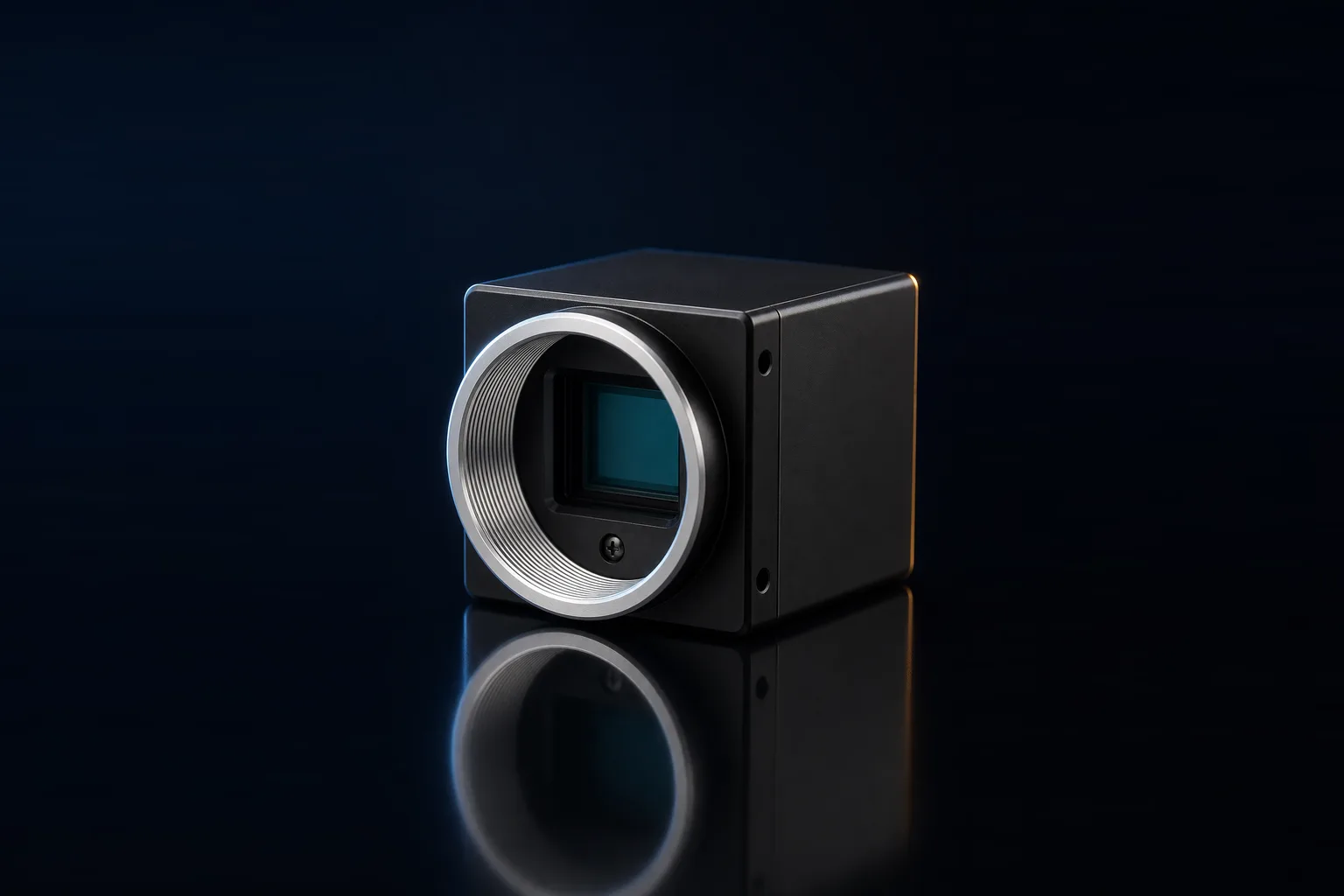
Hikrobot MV-CU050-90GM
- Lead time
- from 5 days
- Warranty
- 36 months
Global-shutter monochrome detail over GigE
A 2600 × 2160 Mono 8 frame gives MV-CU050-90GM the highest monochrome pixel count among these GigE entries. The 1/2-inch GMAX2505 CMOS sensor combines 2.5 µm pixels, global-shutter timing and a 21 fps maximum. Gigabit Ethernet transports the image, while exposure runs from 3 µs to 10 sec and dynamic range is 63.8 dB.
Fine edge, profile and assembly-feature measurement on moving parts can use the dense intensity grid and simultaneous exposure. The 3 µs minimum supports short integration under sufficient light, and 0–12 dB gain provides the stated adjustment interval. Optional PoE can share the data cable; the P7 connection adds one isolated input, one isolated output and one bidirectional non-isolated I/O.
MV-CU050-90GC keeps the GMAX2505, resolution and 21 fps but adds Bayer BG 8 color. MV-CU050-90UM changes to USB 3.0 and reaches 59.8 fps at the same Mono 8 resolution in a 35.6 mm-deep housing. MV-CU050-30GM runs at 24 fps with 2592 × 1944, an AR0521 and rolling shutter. Pick 90GM for high-resolution Mono 8 with global exposure and a GigE connection.
Specifications
| Shutter | global |
| Sensor model | GMAX2505 |
| Nominal optical sensor format | 1/2″ |
| Sensor resolution | 2600×2160 px |
| Maximum frame rate | 21 fps @ Mono8, resolution 2600×2160 px |
| Color mode | mono |
| Lens mount | C-mount |
| Data interface | GigE (Fast Ethernet compatible) |
| Sensor technology | CMOS |
| Pixel size | 2.5×2.5 µm |
| Dynamic range | 63.8 dB |
| Signal-to-noise ratio | 37 dB |
| Exposure time | 3…10000000 µs |
| Auto exposure | Off, Once, Continuous |
| Gain | 0…12 dB |
| Pixel format | Mono8, Mono10, Mono10Packed, Mono12, Mono12Packed |
| Binning | 1x1, 2x2, 4x4 |
| Decimation | 1x1, 2x2, 4x4 |
| Protocol compatibility | GigE Vision, GenICam |
| Communication protocol versions | GigE Vision 2.0 |
| Third party software protocol | GigE Vision |
| Client software | MVS |
| Operating systems | Windows XP (32/64-bit), Windows 7 (32/64-bit), Windows 10 (32/64-bit), Linux (32/64-bit), macOS (64-bit) |
| Digital I/O lines | 1 input, opto-isolated, line 0; 1 output, opto-isolated, line 1; 1 bidirectional line, non-isolated, line 2 |
| Digital input count | 1 |
| Digital output count | 1 |
| Digital I/O connector | P7 6-pin |
| Power supply | 9…24 V |
| Power delivery | external power supply |
| Power consumption | 2.3 W (typical) @ DC, supply voltage 12 V |
| Ingress protection | IP30 |
| Working temperature | 0…50 °C |
| Storage temperature | -30…70 °C |
| Humidity | 20…95 % |
| Dimensions | 29×29×47.6 mm |
| Weight | 117 g (approx.) |
| Certification | CE, RoHS, KC |
| Reverse image | horizontal, vertical |
Documents
Engineering data for this model
Calculated by the MVisionPro engineering tools from the passport data of this model for typical tasks. The figures are estimates for preliminary selection.
Engineering conclusion: 18 mm at 300 mm WD gives a 101.83 mm field, so a 100 mm object fits geometrically. The confirmed mode 2600 × 2160 px · 21 fps · Mono8 gives a raw stream of 0.943 Gbit/s over GigE, which fits one link.
Note: Spatial sampling is an engineering estimate; confirm measurement performance by calibration and verify the selected lens installation.
Field of view with a standard lens
| Task | Standard lens | Field of view at the task distance | Distance for the exact field |
|---|---|---|---|
| 100 mm object at 300 mm | 18 mm | 101.83 mm | 294.92 mm |
| 200 mm object at 500 mm | 14.8 mm | 213.09 mm | 470.18 mm |
Resolution on the object
| Requested field of view | Sampling density | Object pixel | Minimum defect (5 px) |
|---|---|---|---|
| 100 mm | 26 px/mm | 38.46 µm/px | 0.1923 mm |
| 200 mm | 13 px/mm | 76.92 µm/px | 0.3846 mm |
Depth of field and motion
| Requested field of view | Depth of field | Exposure limit (1 px blur) |
|---|---|---|
| 100 mm | 10.08 mm at f/4 | 76.9 µs at 500 mm/s |
| 200 mm | 39.1 mm at f/4 | 76.9 µs at 1000 mm/s |
Data stream by interface
| Confirmed mode | Passport condition | Interface | Raw stream per camera |
|---|---|---|---|
| 2600 × 2160 px · 21 fps · Mono8 | 21 fps @2600 × 2160 Mono 8 | GigE | 0.943 Gbit/s |
Compatible lenses and cables
| Type | Model | What was checked |
|---|---|---|
| Lens | MVL-HF0824M-10MP | Mount, sensor coverage and the optical task of the scenario |
| Lens | MVL-HF0828M-6MPE | Mount, sensor coverage and the optical task of the scenario |
| Lens | MVL-HF1228M-6MPE | Mount, sensor coverage and the optical task of the scenario |
| Lens | MVL-HF1628M-6MPE | Mount, sensor coverage and the optical task of the scenario |
| Lens | MVL-KF0814M-12MPE | Mount, sensor coverage and the optical task of the scenario |
| Lens | MVL-KF0818M-12MP | Mount, sensor coverage and the optical task of the scenario |
| Cable | MV-ACC-01-1101-5m | Data role, interface family, connector path and 5 m length |
| Cable | MV-ACG-RJ45s(up)-RJ45-HF-5m | Data role, interface family, connector path and 5 m length |
| Cable | MV-ACG-RJ45s(up)-RJ45-ST-5m | Data role, interface family, connector path and 5 m length |
| Cable | MV-ACG-RJ45s-RJ45-HF-5m | Data role, interface family, connector path and 5 m length |
How these figures were calculated
- Assumption: Thin-lens approximation; working distance is measured from the principal plane.
- Assumption: The primary optical calculation uses the sensor width and field-of-view width.
- Assumption: The standard focal length is selected downward and its actual field of view is checked.
- Assumption: Object-space resolution is calculated independently for each requested axis.
- Assumption: Motion speed is constant along the selected motion axis.
- Assumption: Depth of field uses a two-pixel circle of confusion.
- Assumption: Stream bandwidth uses the confirmed wire bits per pixel before protocol overhead.
- Assumption: A selected camera is checked only against its passport interface profile.
- Warning: The passport frame rate is tied to the stated mode conditions.
Engineering tools
Configure a kit · Check interface · Calculate optics for this camera
Guide: Choosing a lens when the working distance is fixed · Exposure, motion blur and strobe
Selection and applications
Fine monochrome edge measurement. Global-shutter profile inspection. High-resolution GigE feature checks.
Minimum kit: Pair the camera with a C-mount lens covering the 1/2-inch sensor, a Gigabit Ethernet cable, and optional PoE or a 9–24 V DC supply.
Nearby in the range: MV-CU050-90GC — Use it for Bayer BG 8 color at the same 2600 × 2160 and 21 fps; MV-CU050-90UM — Use it for Mono 8 at 59.8 fps over USB 3.0; MV-CU050-30GM — Use it for a 2592 × 1944 AR0521 rolling-shutter image at 24 fps.
Cables and accessories for this model
Compatibility per manufacturer data.
- Data cables
- GigE
- I/O & power cables
- Hirose 6-pin IO
- Power
- Power
- Mounting
- Camera mounts
FAQ
What monochrome detail does MV-CU050-90GM deliver per frame?
The camera outputs 2600 × 2160 Mono 8 from a GMAX2505 sensor with 2.5 µm pixels. This provides the stated 5.6 MP intensity grid for fine edge, profile and assembly-feature analysis at up to 21 fps.
How do the global shutter and 3 µs exposure work together?
The global shutter gives common exposure timing across the moving frame, while the 3 µs lower limit can reduce blur under adequate illumination. Exposure can also extend to 10 sec, and gain runs from 0 dB to 12 dB.
Which C-mount lens should cover the 90GM image sensor?
The lens needs an image circle for a 1/2-inch sensor and enough resolving ability for the selected object sampling across 2600 × 2160. The GMAX2505 pixel pitch is 2.5 µm × 2.5 µm.
What power paths accompany the MV-CU050-90GM GigE link?
The camera accepts 9–24 V DC and offers optional PoE. Typical consumption is 2.3 W at 12 V DC. Gigabit Ethernet carries the image data and is also listed as compatible with Fast Ethernet.
What housing protection and operating range does 90GM have?
The 117 g enclosure measures 29 mm × 29 mm × 47.6 mm. It is IP30 with proper lens installation and wiring and operates from 0 °C to 50 °C at 20–95% RH without condensation.